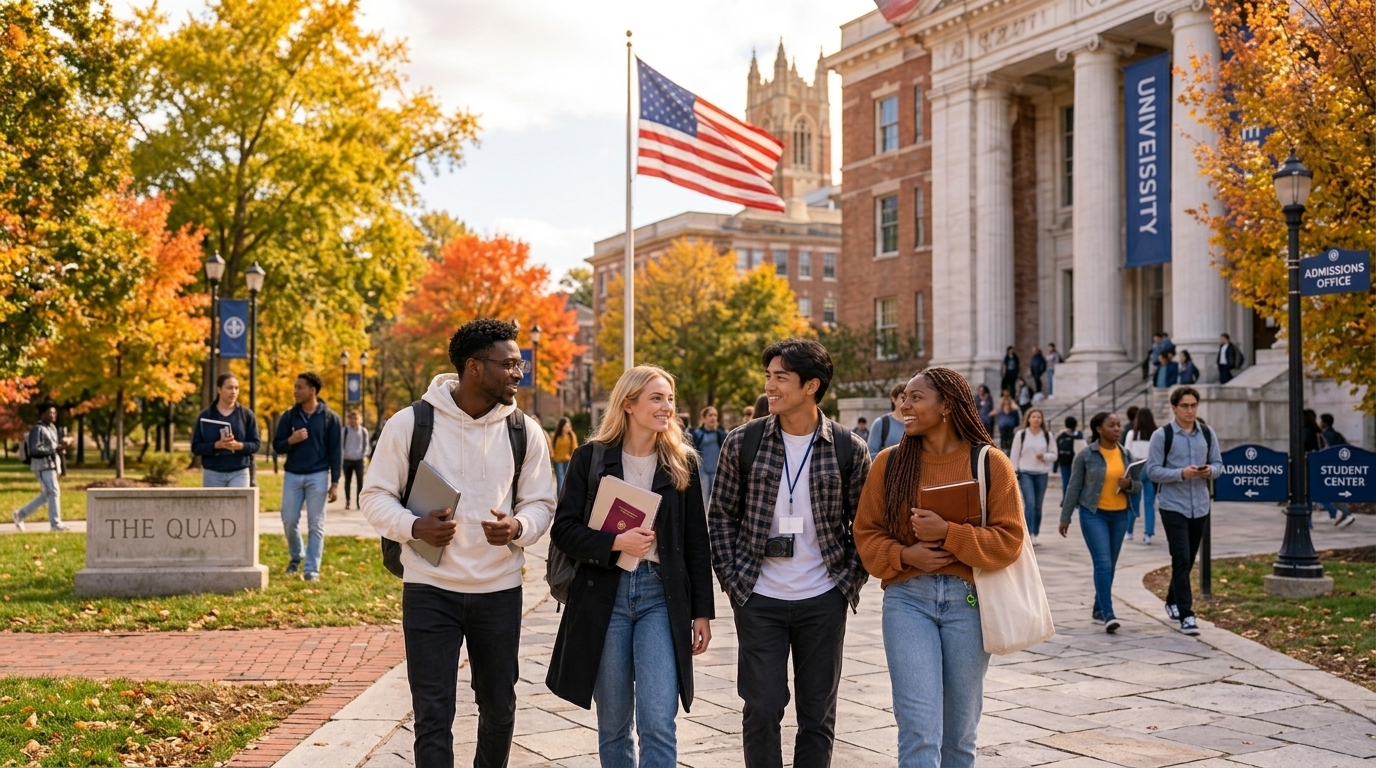
The United States hosts the world’s largest concentration of top-tier research universities, regional state institutions, and community colleges. For West African students, pursuing an undergraduate or graduate degree in the US opens doors to cutting-edge research laboratories, Optional Practical Training (OPT) in major commercial hubs, and flexible academic curricula.
However, the US higher education system operates on a unique decentralized model. From securing your Form I-20 and paying the SEVIS fee to facing the in-person F-1 consular interview, preparing a competitive application requires foresight and rigorous preparation.
At J29 Edu Consulting, our guiding principle remains clear: We tell you the truth about your options — and we stay with you until you’re in.
Whether you are a secondary school graduate aiming for a Bachelor’s degree or an experienced professional pursuing a Master’s or PhD, this comprehensive guide explains how higher education in the United States works and how to navigate the process step-by-step.
1. Understanding Education Options in the US
US higher education is structured around flexibility, general education breadth at the undergraduate level, and specialized research or professional focus at the graduate level.
Universities (Public vs. Private)
- Public State Universities: Large, state-funded institutions offering extensive academic departments, research centers, and varied tuition structures.
- Private Universities & Liberal Arts Colleges: Independent institutions with smaller class sizes, comprehensive financial aid resources (at select elite institutions), and high-touch academic mentoring.
- Undergraduate Degrees (Bachelor’s – BA, BS): 4-year programmes. Students enter with a intended area of study but often finalize their “Major” during their second year after completing general education requirements.
- Graduate Degrees (Master’s – MA, MS, MBA): 1 to 2-year specialized degree programmes focused on technical skill acquisition, professional leadership, or research preparation.
- Doctoral Degrees (PhD): 4 to 6-year research-intensive qualifications, frequently offering graduate teaching or research assistantships (TA/RA) that include tuition coverage and living stipends.
Community Colleges & Pathways
- Associate Degrees (AA, AS): 2-year practical or academic diplomas awarded by Community Colleges.
- 2+2 University Transfer Pathways: Students complete 2 years at an affordable community college and transfer earned credits directly into the 3rd year of a partner 4-year university to earn a Bachelor’s degree at a significantly lower overall cost.
2. Choosing the Right School and Programme
Selecting an institution in the US requires evaluating factors beyond brand recognition:
- SEVP Certification:The institution must be certified by the Student and Exchange Visitor Program (SEVP) to issue the Form I-20 required for your F-1 student visa.
- STEM Designation: For postgraduate applicants in technical fields, choosing a STEM-designated programme qualifies you for a 24-month extension on your standard 12-month Optional Practical Training (OPT), allowing up to 36 months of post-graduation work authorization in the US.
- Academic Match & Institutional Funding: Evaluate whether your academic profile qualifies you for merit-based departmental scholarships, graduate assistantships, or tuition waivers to lower net costs.
J29 Edu Consulting assesses your academic credentials, professional goals, and financial profile to identify accredited US universities where you are competitively positioned for both admission and visa approval.
3. Admission Requirements
Because US admissions are holistic, universities evaluate applicants on academic transcripts, standardized test performance, essays, and leadership potential.
Documentation Checklist:
- Valid International Passport (Bio-data page)
- Official Transcripts (WASSCE/NECO for Undergraduates; University Transcripts for Postgraduates)
- Evaluation Reports (WES/ECE credential evaluations when required by specific institutions)
- Statement of Purpose (SOP) / Personal Essay
- 2–3 Academic and Professional Letters of Recommendation
- Curriculum Vitae (CV) / Resume
- Standardized Test Scores (SAT/ACT for select Undergraduates; GRE/GMAT for select Graduate programmes — though many schools offer waivers)
- Proof of English Proficiency (IELTS, TOEFL, Duolingo, or WAEC English Waiver requests)
Academic & English Language Requirements
- Undergraduate Entry: WASSCE or NECO results with strong credit passes. Many US institutions offer direct entry, while others request a WES evaluation to convert grades into a 4.0 GPA scale.
- Graduate Entry: A recognized 4-year Bachelor’s degree (or equivalent). Students holding a 3-year degree may require a credential evaluation or bridge coursework depending on the university’s policy.
- English Proficiency: Most US universities accept WAEC/NECO English grades (C6 or better) as proof of English proficiency, while others require official scores from TOEFL iBT, IELTS Academic, or Duolingo English Test (DET).
4. The Step-by-Step Application Process
Planning 10 to 12 months in advance is standard for US admissions due to early priority deadlines, financial document reviews, and visa wait times.
Phase 1: School Selection  ──►  Phase 2: Holistic Application
                                             │
Phase 4: I-20 & F-1 Visa   ◄──  Phase 3: Offer & Financial Verification
- Phase 1: Shortlisting & Test Prep: Identify 4–6 target universities and complete necessary standardized or language tests.
- Phase 2: Application Submission: Submit applications via the Common Application (Undergraduate) or university graduate portals prior to institutional deadlines (Fall priority deadlines typically run November through February).
- Phase 3: Admission & Financial Documentation: Upon receiving an admission offer, submit certified bank statements and an Affidavit of Support to the university’s International Student Office.
- Phase 4: Form I-20 Issuance: The university generates your official Form I-20 (Certificate of Eligibility for Nonimmigrant Student Status).
5. Costs, Tuition, and Financial Planning
US higher education requires detailed financial planning. Before issuing a Form I-20, a university must verify that you have full liquid funding for your first year of study.
Average Annual Tuition Fees (USD)
- Community Colleges: $8,000 – $14,000 USD per year
- Public State Universities: $18,000 – $35,000 USD per year (out-of-state rate)
- Private Universities: $30,000 – $60,000+ USD per year
Living Expenses & Health Insurance
Estimated living expenses (housing, food, transport, books) mandated on the Form I-20 range from $12,000 to $22,000+ USD per year depending on campus location (rural vs. major metropolitan areas). Health insurance is mandatory and typically costs $1,500 – $3,000 USD per year.
Official Proof of Funds Formula for Form I-20
$$\text{Total Mandatory I-20 Amount} = \text{First-Year Tuition} + \text{Estimated Annual Living Costs} + \text{Mandatory Health Insurance \& Fees}$$
Scholarships & Financial Aid
- Undergraduate: Merit-based scholarships awarded directly upon admission based on high GPA or test scores.
- Graduate: Graduate Assistantships (Graduate Teaching Assistantships – GTA, or Graduate Research Assistantships – GRA) that grant a monthly living stipend alongside full or partial tuition coverage.
6. F-1 Student Visa & Interview Process
Admission to a US university and receipt of a Form I-20 does not guarantee a student visa. All F-1 visa applicants must attend an in-person interview at the US Embassy or Consulate.
Key Visa Steps & Costs
- SEVIS I-901 Fee:$350 USD (Paid online via the SEVP portal after receiving your I-20).
- DS-160 Online Application: Complete the Nonimmigrant Visa Application form accurately.
- MRV Visa Application Fee:$185 USD.
- F-1 Consular Interview: An in-person interview focused on three core pillars:
- Academic Readiness: Demonstrating genuine academic intent and knowledge of your chosen programme and university.
- Financial Capability: Proving your family or sponsor has legitimate, verifiable funds to cover your education without relying on unauthorized off-campus employment.
- Nonimmigrant Intent (Section 214(b)): Convincing the consular officer that you have strong economic, social, or familial ties to your home country and intend to return after completing your studies.
7. Recommended Timelines and Common Pitfalls
Application & Visa Timeline
- 10–12 Months Before Intake: Prepare for tests (if taking), evaluate universities, and draft SOPs.
- 7–9 Months Before Intake: Submit university applications; apply for graduate assistantships.
- 4–6 Months Before Intake: Accept admission offer, submit financial proof, and request Form I-20.
- 3–4 Months Before Intake:Pay SEVIS I-901 fee, complete Form DS-160, and schedule your US Embassy interview appointment.
- 1–2 Months Before Intake: Attend visa interview, complete pre-departure orientation, and arrange travel.
Avoidable Pitfalls
- Memorized Interview Answers: Reciting rigid, scripted responses during the visa interview rather than engaging in a natural, authentic conversation with the consular officer.
- Vague Financial Explanation: Inability to clearly explain your sponsor’s source of income, business activities, or relationship to you beyond presenting a bank statement.
- Mismatched Academic Logic: Applying for a degree field completely unrelated to your past background without a clear career rationale.
8. How J29 Edu Consulting Supports You
At J29 Edu Consulting, we assist applicants through every stage of the US admissions and visa framework:
- School & Assistantship Strategy: Shortlisting accredited US institutions aligned with your budget, academic strengths, and scholarship/assistantship goals.
- Application Portfolio Review: Structuring your Statement of Purpose, resume, and recommendation letters to meet US university evaluation criteria.
- I-20 Documentation Guidance: Ensuring financial sponsorship documents and bank records meet international student office compliance standards.
- Intensive F-1 Interview Coaching: Conducting structured mock interviews to build clarity, confidence, and articulation around your study plan, finances, and post-graduation goals.
- Pre-Departure Support: Guiding you on US campus arrival policies, health insurance setup, and travel logistics.
Ready to Explore Your Study Abroad Options?
You don’t need to have every detail figured out today. Tell J29 Edu Consulting about your academic background, career ambitions, and preferred study destinations, and we will help you map out a realistic path forward.
Submit an Inquiry with J29 Edu Consulting
- Website:j29educonsulting.com
- Email:hello@j29mmigration.com
- Phone: +1 437 600 3087
- Toronto Office: 18 King Street East, Suite 1400, Toronto, ON M5C 1C4, Canada
Frequently Asked Questions
Q1: What is the difference between an I-20 and a Visa?
The Form I-20 is an official certificate issued by an SEVP-certified US school confirming your admission and financial eligibility. The F-1 Visa is a travel document placed in your passport by a US Embassy or Consulate allowing you to request entry into the United States at a port of entry.
Q2: Can international students work in the US on an F-1 visa?
Yes. F-1 students are permitted to work on-campus up to 20 hours per week during academic terms and full-time during official breaks. Off-campus employment is restricted and requires explicit authorization via Curricular Practical Training (CPT) or Optional Practical Training (OPT).
Q3: What is OPT and STEM OPT?
Optional Practical Training (OPT) allows F-1 graduates to work in their field of study anywhere in the US for up to 12 months post-graduation. Graduates from STEM-designated (Science, Technology, Engineering, Math) degree programmes are eligible for a 24-month extension, totaling 36 months of work authorization.
Q4: Can my relative in the US act as my financial sponsor?
Yes. A US relative or family member can sponsor your education by providing an Affidavit of Support (Form I-134 or university equivalent), current bank statements, and tax returns (IRS Form W-2 or 1040). However, you must clearly explain your relationship and their willingness to fund your education during your visa interview.
Q5: Does a university admission offer guarantee visa issuance?
No. Consular officers independently assess every F-1 visa application based on academic intent, financial sustainability, and intent to return to your home country. Admission decisions remain entirely separate from immigration determinations.